


What Happens After Arrival Decides Who Pays.
Most exporters don't lose money because their shipment was delayed, inspected or questioned in Dakar. They lose money later, when a buyer challenges the shipment, unexpected costs are passed back to them, responsibility becomes disputed, or an insurance claim requires proof they cannot provide.
Unexpected charges, disputed claims and commercial disagreements are rarely decided by who argues the hardest. They are usually decided by who can support their position.
The Port Rarely Decides What You Lose. The Commercial Discussion Does.
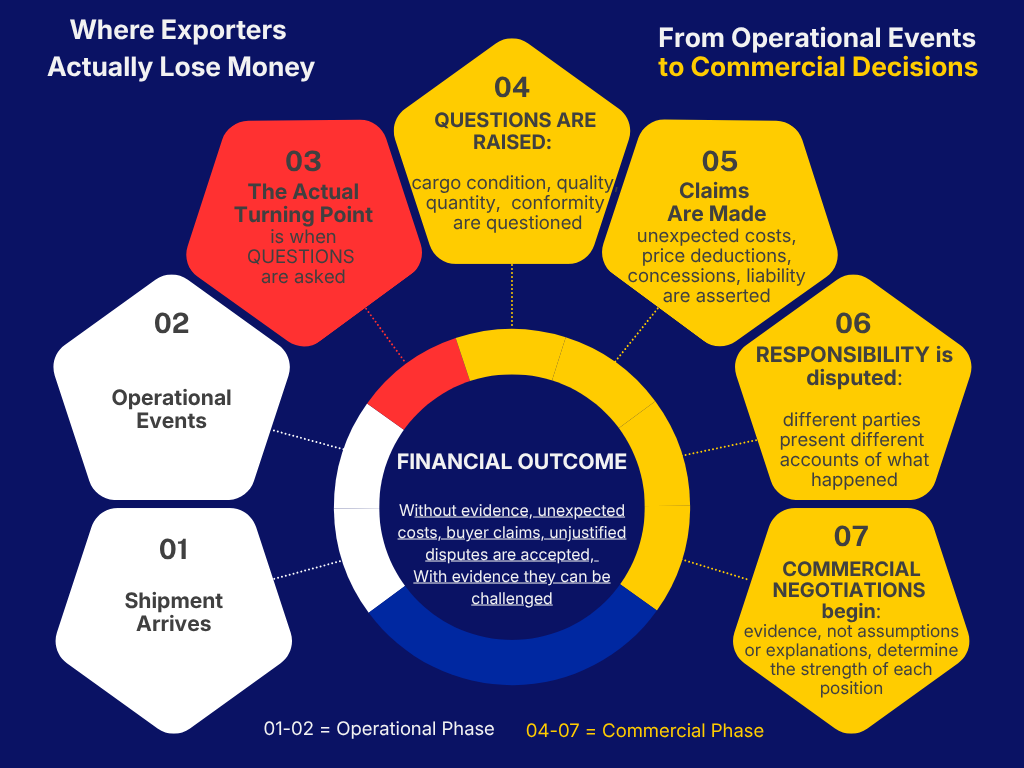
Most exporters assume the greatest financial risk comes from customs inspections, cargo delays, containers selected for physical examination, delivery delays or additional charges inside the port. In reality, none of these events automatically determines who ultimately bears the financial loss. The real financial impact usually begins later, when responsibility is disputed, when a buyer, insurer or another party questions what happened, commercial decisions have to be made, and the exporter has no evidence to defend their position.
The financial outcome is usually decided later, when a buyer questions the condition, quantity, specification or conformity of the goods, when unexpected storage charges, inspection costs or other additional expenses are passed back to the exporter, when an insurer asks whether there is sufficient evidence to support a claim, or when responsibility for delays, damage or missing cargo becomes disputed.
At that point, the exporter with the evidence enters the discussion from a position of strength. The exporter who cannot is often left relying on explanations rather than evidence.
The sequence below shows where operational events end and commercial consequences begin.
Different Cargo. Different Buyers. The Same Commercial Negotiations, Again and Again.
Once a shipment reaches Dakar, the financial outcome is rarely decided by the operational event itself. It is usually decided later, during one of five commercial negotiations. Each begins when questions are raised about the shipment and ends with one side or the other absorbing the cost.
Every shipment is different, but these commercial negotiations are remarkably similar. Whether you export fresh produce, machinery, chemicals or construction materials, they all eventually come down to the same question: can you support your position with evidence? When questions are raised, the side with the evidence usually has the stronger position.
01
Your Buyer Challenges the Shipment
Your buyer claims the goods arrived damaged, incomplete, below specification, in smaller quantities than expected, or not in the agreed condition. Instead of simply accepting the shipment, the buyer begins questioning whether the agreed price, payment or contractual obligations should still apply.
When concerns are raised about the shipment, when a buyer believes the shipment does not meet the agreed contract, the discussion quickly shifts from delivery to commercial negotiation. The exporter may be pressured to accept a price reduction, a payment delay, a compensation claim or another commercial concession.
Without evidence showing what actually happened during the shipment's arrival and release, the condition of the cargo, the quantity received and the key events surrounding its handling, the discussion quickly becomes one account against another.
Unexpected costs, disputed insurance claims and commercial demands become far more difficult to challenge because there is nothing to support the exporter's version of events.
02
An unexpected charge appears.
A documentation query, a customs valuation challenge, or an unexplained hold turns into an additional charge you were not budgeting for, storage fees, a demurrage bill, or a cost passed on by your consignee.
The charge may be partially justified or entirely avoidable, but the exporter is now being asked to bear the financial consequence.The discussion quickly moves beyond the existence of the cost itself. The real question becomes whether the exporter is genuinely responsible for paying it.
Instead of a fixed, predictable expense, you are presented with a figure and expected to accept it. Without a record showing when the issue arose, what caused it, and who was responsible for the delay, you have no basis to question the amount or who should actually be paying it.
Charges that should be questioned are often accepted because there is no evidence available to challenge them. The charge becomes yours to absorb, not because it was yours to begin with, but because nobody can show otherwise.
03
Responsibility for a delay becomes disputed.
The shipment is delayed, your cargo is released later than scheduled, delivery commitments are affected, and additional costs begin to accumulate. What initially appears to be an operational issue quickly becomes a commercial question.
The discussion soon turns to responsibility. The buyer may argue the exporter is responsible. Another party may point to customs procedures, inspections, documentation issues or events inside the port. Instead of a clear cause you can point to, you are left with several conflicting explanations, none of which you can independently verify. Each explanation carries different financial consequences.
Without a timestamped record of what happened, when it happened and how decisions were made throughout the process, you cannot establish which party's action, or inaction, actually caused the delay, determining responsibility becomes difficult.
When responsibility cannot be clearly established, the cost of that delay, in storage, in a missed delivery commitment, or in your buyer's patience, is rarely resolved in your favour. The financial consequences are often pushed towards the party least able to challenge them, because furthest from what actually happened.
04
For Your Insurance Claim, A Marine Survey Doesn't Tell the Whole Story
When cargo is damaged, short, or delayed, insurers commonly appoint an independent marine surveyor to inspect the goods, establish the cause, and assess the extent of the loss. That survey is a normal, expected part of any serious claim, and PFS does not replace it.
What a surveyor cannot do is account for what happened before they were called, what took place during customs clearance, when a seal was opened, or what condition the cargo was in earlier in its time at the port. Those are exactly the gaps that weaken a claim, not because there was no survey, but because there is no record of the period the survey never covered.
Evidence created while events are taking place helps establish a clearer sequence of what happened before the surveyor arrives. Timestamped photographs, inspection records, seal information, container condition, handling activities and the chronology of key events provide context that cannot usually be reconstructed afterwards.
Used alongside the marine survey, this evidence helps surveyors, insurers and exporters, understand the sequence of events, assess responsibility more accurately, evaluate the claim on documented facts rather than assumptions, , rather than leaving a gap in the timeline for the insurer to interpret in their own favour.
05
You are asked to respond without being able to prove your position.
A counterparty, an insurer, a consignee, raises a question about your shipment, a buyer disputes the goods, additional costs are presented, responsibility becomes contested. You, the exporter, are expected to explain what happened and defend your commercial position. You explain what you believe happened, based on secondhand updates and your own assumptions.
By this stage, every party already has its own records, explanations and version of events. Shipping lines document their operations. Terminals record their activities. Customs records its inspections. Freight forwarders and customs brokers document the parts of the process for which they are responsible. None of them are creating a complete evidential record for the exporter's commercial protection.
When the discussion begins, the exporter may discover there is nothing documenting events from their own perspective. Instead, they are left relying on explanations, fragmented records and information produced by parties with their own responsibilities and interests to protect.
The exporter with evidence enters the discussion from a stronger commercial position. The exporter without it is often left trying to defend a position using information that was never created to protect their interests.
Everyone Involved Has a Role. Protecting You Isn't One of Them.
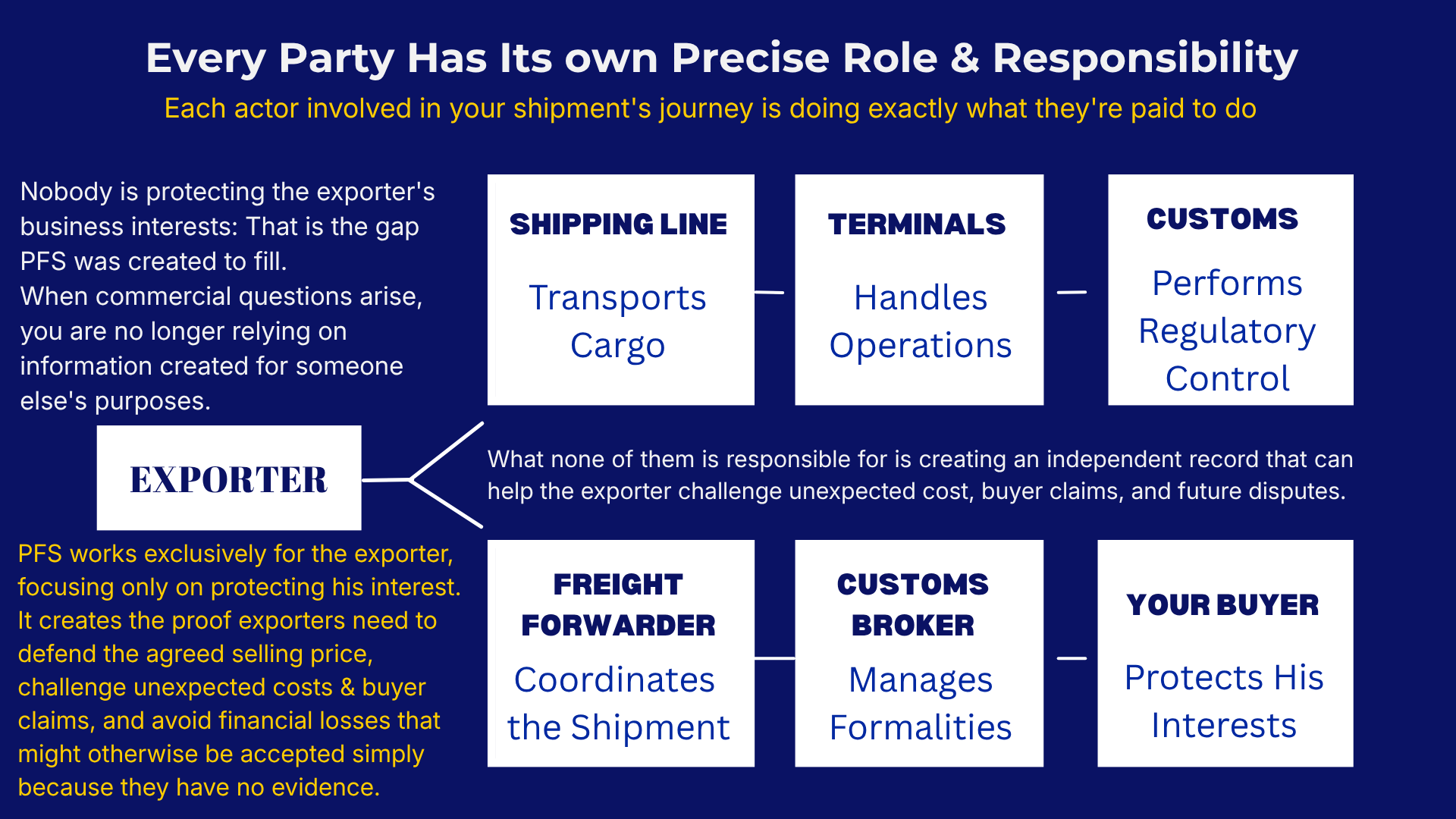
There is nothing wrong with how Dakar port operates. Every party in your shipment's journey is doing exactly what they're paid to do, and doing it competently. Your shipping line transports the cargo. The terminal handles it. Your freight forwarder coordinates the logistics. Your customs broker manages the formalities. Your buyer protects their own commercial interests, and is entitled to.
Each performs its own role professionally and for its own purpose.The issue is not any of these roles. It is that none of them is responsible for building a complete, independent record for you specifically, one that exists to protect your position, not theirs, if a question is later raised.
When a buyer challenges the shipment, unexpected costs appear, responsibility becomes disputed or an insurance claim is investigated, every party already has information supporting its own role. The exporter often discovers that nobody has been documenting events specifically to protect their interests.
That is why commercial discussions so often become one explanation against another. Operational records exist throughout this chain, waybills, manifests, customs filings. What is often missing is the commercial record built for the exporter, the evidence the exporter needs when the commercial discussion begins.
It Is Rarely One Cost. It Is All Five, Compounding.
Section 3 showed five commercial negotiations that can each cost you money on their own: a price reduction you never budgeted for, an unexpected charge you cannot challenge, a delay nobody accepts responsibility for, an insurance claim that cannot be fully supported, or a commercial question you cannot answer with confidence. Most exporters experience these as separate, unrelated incidents. They are not separate. They are the same structural weakness, revealing itself in five different ways, on the same shipment or across many shipments.
A shipment that ends with a 5% price reduction. Another where unexpected storage charges are accepted. A third where part of an insurance claim cannot be fully supported. Individually, none of these events may threaten the business. Together, they become recurring commercial leakage that many exporters gradually accept as part of doing business in Dakar, rather than recognising it as the cost of entering every commercial discussion without evidence.
There is a second cost that never appears on an invoice. A buyer who successfully negotiates a price reduction once is more likely to challenge future shipments. A relationship that begins with concessions rather than documented facts often establishes a commercial pattern that becomes increasingly difficult to reverse. That cost rarely appears in your accounts, but it compounds long after a single shipment has been completed.
Doing nothing does not prevent the next dispute. It simply means the next buyer challenge, unexpected charge, insurance claim or responsibility dispute begins exactly as the last one did, with one party presenting evidence and the exporter under pressure to accept costs, concessions or reduced payments that could otherwise have been challenged.
The Missing Evidence Is Created Before It Is Needed.
Every party in your shipment's journey has a defined role. None of them includes creating a record built specifically to protect your commercial position. That is the gap PFS exists to fill, not by managing your shipment, but by documenting it independently, while it happens, before any question is ever raised.
Throughout the shipment's arrival, inspections, release and other significant operational events, information is documented from the perspective of the exporter, before commercial questions are ever raised.
When a buyer challenges the shipment, unexpected costs are passed back to you, responsibility becomes disputed or an insurance claim is assessed, you are no longer forced to choose between accepting the financial loss or arguing without proof. You are able to challenge unsupported claims, question unexpected costs, support insurance claims and negotiate from a stronger commercial position because you have the completion report: proof, timestamped documented facts of what happened, how, and when.
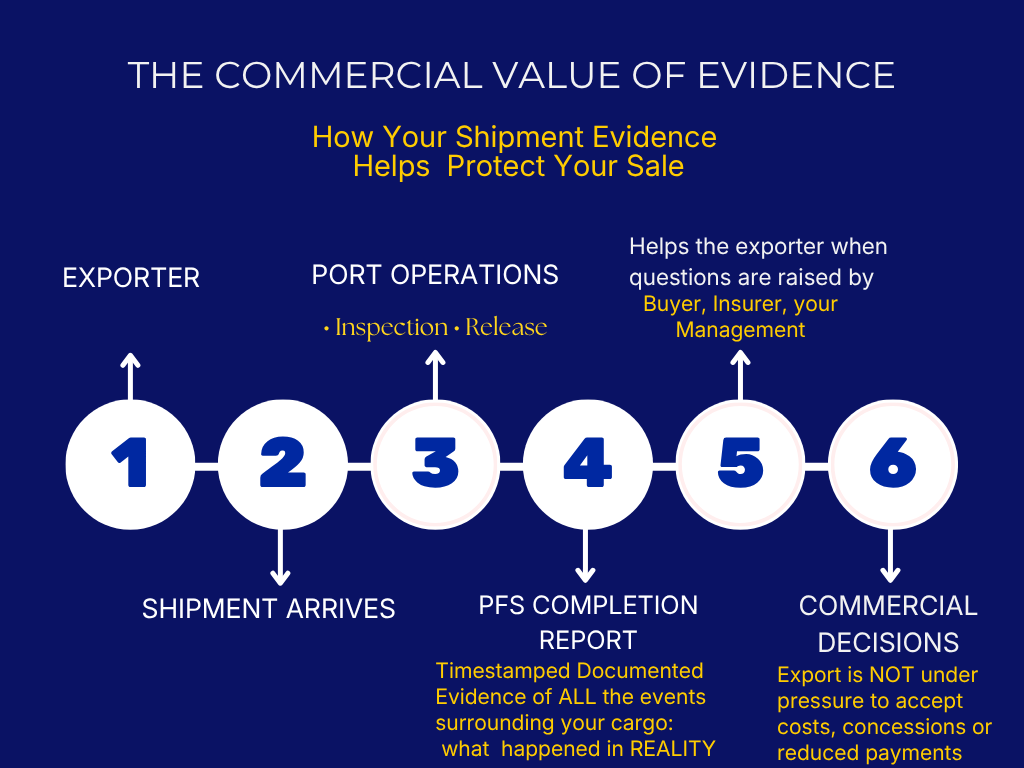
The commercial value of evidence is not measured while your shipment is moving through the port. It is measured later, when you are able to protect your margin, avoid financial losses , recover legitimate insurance claims and challenge disputes with EVIDENCE
What a Stronger Commercial Position Actually Looks Like
PFS does not change what happened to your shipment. It changes what you are able to protect when commercial questions arise.
When a buyer asks for a price reduction, unexpected costs are passed back to you, an insurer assesses a claim or responsibility becomes disputed, your objective is not simply to explain what happened. It is to protect the value of your sale, avoid unnecessary financial losses and challenge commercial demands you should not have to accept.
The difference is not the shipment itself. The difference is whether you are in a position to question deductions, resist unsupported claims and negotiate from strength instead of feeling pressured to absorb costs that may never have been yours to bear.
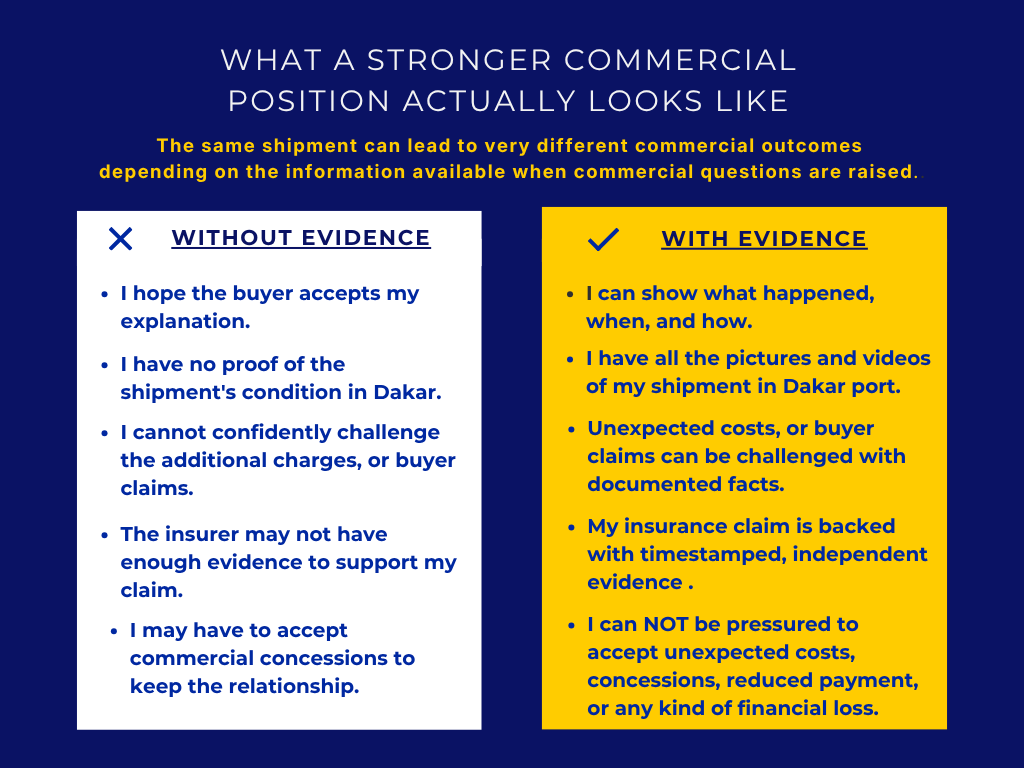
A stronger commercial position does not eliminate commercial disputes. It helps you protect your margin, question unexpected costs, avoid financial losses that might otherwise have been accepted without question.It enables the exporter to avoid losing money simply because you were unable to challenge commercial claims, and disputes raised.